I used to work at a design services company – our offering was a combination of contract design services (you pay us and we do clever stuff for you) and intellectual property licensing (we develop some clever engineering and you pay us a licence fee to use it). A couple of weeks ago I went to a reunion dinner with some ex-colleagues from that company. It’s always interesting to see the different paths people take on their career journeys, and they were a good bunch of guys.
One of those at dinner had joined the company fresh from university. Bright, genial, entrepreneurial and still frighteningly young he has now started his own product company, developing a device in a challenging consumer market area. As might be expected, the product has some very clever engineering and delivers startlingly impressive performance. He appeared on Dragons’ Den and turned down their offer.
Now I see the importance of marketing
I was really pleased to hear him utter those words. I’ve never been a marketing professional but I’ve worked with some very talented marketing people and recognised the immense value of their work. I’ve also spent a lot of my career trying to create revenue in technical companies which didn’t see the value of marketing. Our young entrepreneur continued: “I thought that since we had developed a brilliant product people would just buy it.” So many technical companies believe in “build it and they’ll come”. They polish the technical offering and wait for the customers – and then polish some more. They hire salesmen, and then fire them when they don’t make sales. My approach was to try to fill the marketing gap to provide the foundation upon which I could sell. Sometimes companies got it, more often they didn’t.
I’m so happy that at least one clever technical guy has learnt that good marketing is essential for business success.
5 miles through the Suffolk countryside (click to enlarge)
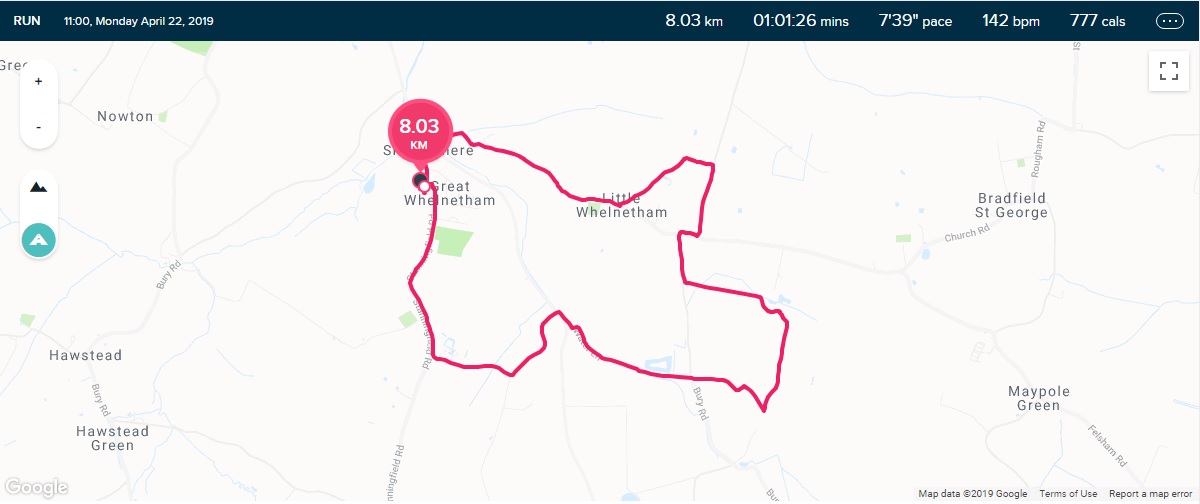
I’m writing this on the Tuesday before the Marathon – 5 sleeps to go. I’m well into my taper now, and no issues so far. While I’m running a lot less than at the peak, I guess by the standards of most people (especially people of my age) I’ve still covered a fair distance in the last couple of weeks. I’m now talking in terms of my last long run being “just a half marathon”. Last week my daily runs stayed at 10.5 km, but I’ve been trying to run them gently. Yesterday, which would have been long run day, I went out in glorious sunshine intending to run 5 km, but couldn’t resist taking the scenic route and doing 8 km. I don’t feel too guilty about over-doing it, because I succeeded in keeping the pace down to a marathon shuffle, which feels ridiculously slow.
It’s not how fast I go, but the fact I can do it at all!
I’m beginning to understand my pace. If I just run without thinking about it I settle out at 6.5 minute kilometre pace until I get tired, which might be after 8 or 10 miles. If I focus my mind on a controlled push I can take the pace up to 6 minute kilometres for a distance of 10 km or so. With a disciplined focus on slow running the pace comes out at around 7.5 minute kilometres. I can maintain 5 minute kilometres for a mile – that’s an 8 minute mile, and my excuse for the mixed units. I’m sort of happy with that – I was never a great athlete, and the surprising thing now is not how fast I go, but the fact I can do it at all.
I intend just one more run before the event – another gentle run tomorrow. 5 km would be sensible, but if the weather’s nice it might turn out to be another 8 km. I will be focusing on marathon pace, trying to get used to running slower than comes naturally. My sole objective for the Marathon is to finish as elegantly as possible, and I know from running half the distance that the temptation to speed early on will be my enemy, however good it feels at the time.
I’m as ready as I’ll ever be – I’m just hoping above all else that I don’t injure anything or get ill in the next few days.
Just two weeks to go. I’m formally starting my taper from here, although last week (the first week of April) was also lighter than normal because we were in Wales in the motorhome. I managed three runs during that week. Two of them were on tracks in the Brecon Beacons where we were staying. It was very robust countryside and at times snowing too. I was reminded just how tough are the fell runners for whom this type of ground is normal. For me, accustomed to the gentle slopes of Suffolk, running uphill or down was challenging in the extreme. So the week was very different from the training of past months, and the variety was probably good in exercising some muscles that have had it easy when plodding along a tarmac road.
This week I was back to the old routine for just one more time – a long run of about 20 miles, three 6½ milers and a parkrun. I can’t say I’m sorry to have completed the last long run of the training programme – I’ve found them tough, and somewhat scary, with the prospect of having to complete a further 6 miles for the Marathon.
Next week my long run will be scaled back to a slow (marathon-pace) half-marathon distance on Monday, and I’ll probably taper the shorter runs down to 3 miles through the week, ending with a parkrun on Saturday. After that, I’ll have a week off (maybe the odd stretch) until Marathon day on 28th April. I just hope that my body can stay together for two more weeks and that it doesn’t rain on the day.
I’m a creature of habit, so I found it rather unsettling that real life got in the way of doing my long run on Monday – especially since the routine had been disturbed the week before by the taper for the Cambridge Half Marathon, and the event itself.But this week, shock horror, long run day was Tuesday. And after the half marathon break I was back to the 19.5 mile 3/4 marathon long run.
We’ve had remarkably good weather all through the winter, and that has really helped in getting out there for the training runs (which unlike previous years have been almost exclusively outside). But Tuesday was the day that storm Gareth arrived. We got up to find a cold and windy day. Somehow it takes longer to get out of the door when it’s like that. But eventually I was off, having prepared a bottle of plain water for the first of my three 6.5 mile laps, and a couple of Lucozade Sport bottles (acclimatising for the London Marathon) for drink stops as I passed home.
My target for the London Marathon is simply to finish, preferably reasonably elegantly and I’ve realised that, for such a distance, learning to start slowly is key to that. The aim for this run was to practice slow running. My parkrun a couple of days previously fitted in well with that – I had run round gently talking to a friend. For the long run there was no running partner to pace me, apart from Gareth the Gale.
Not only do I normally run alone, but I rarely meet anyone along the way – it’s mostly country lane and farm track. Today was different. First came the man who looked as though he’d just stepped out of All Creatures Great and Small (stories about a veterinary practice in the 1940s). He was in an old Land Rover, dressed in tweed from head to toe, and searching for the Suffolk Hunt Kennel. Conveniently he was very close and I was running that way, so I could put him right.
Then came the tree fellers – two of them, which might confuse an Irish reader. They had been called in to sort out some trees damaged by Gareth and wanted some local knowledge on whether the road was busy. It’s not!
Shortly after that I came upon the man planting a new hedge along a field edge. He was talking to another man in a very big shiny Audi SUV (he probably owns the whole village). I greeted them both and continued on my first lap, moving over shortly afterwards to allow the Audi to overtake as I struggled against the wind blowing across the open fields.
I completed the first lap, picked up a bottle of Lucozade and set off up the hill for lap two. This was less eventful but hedge-planting man was still at it. He greeted me as I panted past, and was somewhat surprised when I said I would be coming back one more time. At the end of lap two, half marathon distance, I was definitely feeling tired. I’d drunk less than half of my sports drink so I continued on to lap three without a stop.
Why does my lap start with an unrelenting kilometre of climbing? I’d been checking my Fitbit all the way to try to ensure that I kept a sensible pace, and trying to do mental arithmetic on my average pace. Battling with a gale, and feeling pretty tired I was convinced it was a slow run. It had started to drizzle on the third lap. By the time I met hedge-planting man for the third time, the rain was getting more insistent. We had a quick chat. I explained this was my third 6.5 mile lap. “One more lap and you’ve done a marathon,” he said perceptively.
One more lap and you’ve done a marathon!
“That’s the plan,” I said. Hedge-planting man had that air of unruffled calm that possibly comes from working outside. It was blowing a gale, and the rain was getting more insistent. But he kept going – no rush, one step at a time. That was a good model for me to follow.
By now I was definitely tired, but I could still plod on. The wind made it hard work, but I knew that would ease once I’d made it through the open fields. The rain wasn’t too bad…
…and then, a mile or so later, it was! I was again heading straight into the wind, with a slight slope helping me. But the rain was torrential – were those just big rain-drops or was it hail? I couldn’t open my eyes. In the middle of the road I turned my back on the wind and tried to clear my eyes. My waterproof jacket was by now clearly not waterproof – I was soaked to the skin. It was cold and windy. I resumed my homeward plod – lucky it was the last lap.
Things became better, the wind eased as I took the turning for the last couple of miles and the rain was past its worst. Keep going, one step at a time, no rush.
The end result? We ran the distance 5 minutes faster than last time – me and Gareth, despite all the stops. Keep going, one step at a time, no rush – hedge-planting man set a good example.
The weather forecast was a bit gloomy for the 2019 Cambridge Half Marathon, especially in comparison to the February heatwave we were enjoying a few days earlier. The actuality was not so bad. The lack of sun made for good running conditions. There was a little drizzle, but not enough to be noticeable while running. And the earlier dry weather meant that the grass at the venue was in good condition – it has been ankle deep mud in the past.
I’ve done every Cambridge Half since it started in 2012. In the past it’s been my highlight event of the year. This year it’s forming a part of my training for the London Marathon, so it felt a little different, but I was still feeling pressure. It wasn’t so much fear of the distance, as it once was, but fear of screwing it up.
“If the Cambridge Half goes wrong, how will you feel about a full marathon a few weeks later?” said a niggling inner voice.
The Cambridge Half would provide a break from the strict training routine I had been following. I would taper, have a couple of days off, and the distance was less than my regular long run. It would also provide an opportunity to practice discipline in my pacing when surrounded by lots of people, as well as rehearsing the slightly surreal atmosphere of a big running event. I know I can survive a half marathon even if I do blow up after eight or ten miles due to an over-ambitious start. That would be more serious for a full marathon, and I know I’ve always felt pretty exhausted at the end of 13.1 miles. My training for the longer distance was suggesting that I had to work on going slowly at the beginning. So the objectives for the day were:
don’t break myself
run a controlled race
feel good at the end
I won’t describe the run in detail, mostly because I don’t remember the details. At the start I was focusing on taking it easy. It felt very easy, and people were overtaking, but my watch told me I was sensible. I then relaxed a bit and focused on staying comfortable. The record says that I was getting a little faster – I was now overtaking people. The halfway point is just after Grantchester, and not long after that we turn right at the roundabout and head back towards Cambridge along the A603 Barton Road. I’ve always enjoyed that part of the run. We’re on the way back, it’s slightly downhill, there’s lots of space – I just feel good.
Finishing straight
I was still restraining my pace – enjoy, but don’t push. It would be all too easy to get carried away, and I know from past experience that the run back through the City can still be very tough, even with all the encouragement from the lovely spectators. But this time it wasn’t. I think it was at the end of Silver Street that I almost tripped over as I tried to skip a little jig to accompany the bag-pipe player. And then with around 2 miles to go, I allowed myself to accelerate. It was less than a parkrun now, and I was still feeling good. I ran those last miles at around my normal parkrun speed, and still had energy for a decent sprint at the end. Unlike last year, my legs were still good, and I didn’t feel faint. I could enjoy the alcohol-free beer and my brain was still working as I unlocked my bike.
Riding back up the Milton Road to the car, there was a following wind. I was on a high and diced irresponsibly with dick-heads in cars as I sped along. I didn’t die.
All in all, it was a good day. The only mistake I made was to forget to stop my watch at the finishing line. It said exactly 2 hours 15 minutes when I did remember. The official time was 2:14:28. A new personal best just before my 66th birthday – and I wasn’t even trying for a time.
With the Cambridge Half Marathon in 6 days time I decided to reduce my long run of the week from the three-quarter marathon of last week to half marathon distance. To make it part of my marathon training, I would run it at something like marathon pace rather than pressing on.
That was the theory. In practice, for the first lap (of two) I was rather faster than marathon pace, but quite comfortable. I picked up another water bottle(with added calories) at the end of the first lap, wasting a bit of time because my wife had locked me out of the front door! Perhaps it was the frustration of that, or knowing that unlike last week I had just one more lap to go, but all my good intentions were thrown aside in that second lap. It started briskly, and just got faster. As I saw the kilometre splits getting faster it spurred me on even more, and the middle 5 kms of that second lap were run in a similar time to my parkrun a couple of days earlier.
So much for plans and discipline – but actually a pretty good outcome. It shows that start slow/get faster can actually produce a decent time. I guess that a slightly faster start might have been faster overall but this was training, and finishing with so much energy shows that the distance training for the full marathon has put me in a comfortable position for running a half – always assuming I stay fit for the next six days.
Of course, the real test comes at the end of April.
Yesterday I ran the longest distance I’ve ever run (31.5 km or 19.5 miles), and for the longest time I’ve ever run (nearly 4 hours). It wasn’t fast, but I was very happy to complete three quarters of a marathon at a consistent pace. It was certainly a lot harder maintaining that pace at the end, but it does show the importance of not blowing all my energy in the first 10 miles.
And just a couple of days ago I surprised myself by running a new personal best time over 5 km at the local parkrun, so it counts as a good week.
The training plans tell me that I’ve now run as long a distance as I need to in training for a marathon, and I certainly feel happier now that if all goes well I do have a hope of finishing – something that didn’t seem so likely just a week ago when I struggled to finish 17 miles. However, the other thing the books say is that the last 6 miles are as hard as the previous 20, so no smug feelings yet. It’s rather tempting to try a run over the full marathon distance just to see what happens. If I made it comfortably (I use the word in relative terms here) it would do wonders for the confidence, but everyone says don’t do it. There’s a risk of breaking myself, and of course it would be very bad for the morale if I wasn’t able to go the distance.
I did the run as 3 laps of a 10.5 km route from home (so 4 laps would be a full marathon), which gave me a chance to pick up water – I find it a nuisance to carry more than half a litre, and that’s not enough for 4 hours of running, even in these relatively cool conditions. In practice I only did one water stop, after the first lap, so I survived on a litre, which is probably less than recommended. The first half litre was just water, the second contained an energy supplement. I didn’t feel particularly thirsty while running, but was certainly pretty dehydrated after I finished.
Learning points?
The run was a successful implementation of good pacing. The intention was to run at around marathon pace, and I was able to maintain that pace consistently and feel that I could have gone further
My feeding and drinking worked fine for that distance, but I think could have been a problem with another 80 minutes or so of running. It would be good to see the effect of another drinks stop
These were the words just a couple of days ago in a Facebook chat with someone I met in the twilight of my career. She wanted to catch up with me to talk about project management – a nice thought, but what have I got to say?
I got to thinking. I spent most of my career doing project management or something very close to it. Even in the last few years when I was supposedly into business development and marketing, a lot of my work was informed by project management experience. It’s a lot easier to sell a project development if you can talk intelligently to the customer about what’s involved. Trouble is, like many areas of expertise, if you know what you’re doing project management seems obvious – until you see how badly some people do it. In this blog I’m simply going to skate over the surface, stating the obvious – I don’t think anyone would want to stick around for the full treatment, and I’m certainly not going to get into a philosophical discussion about waterfall or agile methodologies.
Project delivery happens in phases – some of these can overlap, sometimes they become iterative, but delivery of a project is about moving from nothing but an idea to a set of tangible deliverables. Often when projects go wrong it’s because people forget about some of the phases, and even more commonly they work with a silo mentality, limiting communication across departments and disciplines, which can lead to less than ideal project outcomes.
Concept phase
Someone has an idea which might become a project. But what is it? In this phase we are talking about the “what” and the “why” and emphatically not the “how”. Techies will want to discuss the “how” at the earliest opportunity, and often either forget about the “what” and the “why”, or think they know better than the customer/user/stakeholder. This phase is about defining the requirements. To do it properly we need to work closely with the customer, users and stakeholders, as well as the breadth of company activities such as sales, marketing, finance, customer support and training.
Deliverables – agreement of all parties on the deliverables is crucial. If we don’t know what we’re delivering, how do we know when we’re finished? What is actually wanted? What will it do and why? What are the benefits? Can we identify customers, users and stakeholders and do they agree on the objectives?
Budget – in most environments a project must make financial sense. What budget do we have for delivering the project? How much is it worth spending?
Timescales – a project is usually only valid in a particular timeframe. When is it needed? When would it be too late? Is it possible to be too early?
Planning phase
Once we have a handle on the requirements, we can start thinking about “how” we will deliver. Typically we will discover things in this phase that cause us to go back and consider the requirements. It’s fine to go back and revisit the previous phase, but make sure you don’t get confused between the “what” and the “how”. We still need to be working across the many departments of the organisations involved – very often the technical teams will think that they own this phase. They should not!
Resourcing – we need to determine who will be involved in delivering the project, and where will the money come from. Who is in the project team? Do we need external resources?
Cost – this is deeply dependent on all of the other parameters in this phase. It’s pretty important that the development cost is in line with the budget identified in the previous phase. I have worked on many projects which would not have happened if we’d known the true costs when we’d started. There can be ways around this, such as finding other revenue streams based on the development (maybe technology licensing, for instance). What will it really cost? Who pays if we’ve got it wrong?
Technology – we need to consider the technology we will use for this project, both in terms of the underlying deliverable and the tools used to develop it. What technologies could we use as the basis of the project deliverables? What about development tools? Do we have experience is these technologies? Do we need external resources?
Timescales – this is a different question from that in the previous phase. Then it was “when do we need it?”. Now we’re asking “when can you have it?” How long will it take to create the deliverables? Even if we could estimate perfectly (and we can’t) there is no single answer to this question. The deliverables might come in parts over a period of time, or be delivered in a number of different ways. It might be possible to deliver earlier if we were to spend more money. How long will it really take? Think about risk. You need to be realistic about the timescales and factor in some contingency. If the project is very similar to 10 you have repeatably done before then the contingency can be small. If it’s based on brand-new technology that no-one has ever used, it will probably take twice as long as you think, even when you have factored in some contingency.
Methodology – in the good old days we (in theory) carefully defined a project specification in minute detail before we started the development process. It is fashionable nowadays to use agile development, which takes account of the fact that we don’t know everything we need to know before we start. Each methodology has its advantages – and its disadvantages.
Execution phase
On a technical project, this is what the developers regard as the real work. They start coding and developing the electronics. But in the real world we also need to take into account the needs of the marketing department, sales, customer support, and test teams. Many immature companies regard these as serial activities rather than taking a holistic team approach.
Progress tracking – the methodology zealots will talk of stand-up daily meetings for agile developments, or meticulous tracking of hours spent and earned value for more traditionally run projects. This is what some people regard as the core of project management. Are timescales on track? It’s an easy question to ask, but devilishly difficult to answer. It’s often the case that projects stay on track until the 80% point, and then take as long to finish as they took to get to that point. Are costs on track? This one is probably even more difficult to answer
Customer management – also taking account of users and stakeholders. Is progress what we expected? We need to be setting appropriate expectations. Have we met unforeseen technical obstacles where the customer could help? Sometimes we can struggle expensively to solve a technical problem, when talking to the customer would have established that it’s not important. Are there potential follow-on projects? We might have decided to postpone solving a problem until later, or have identified an opportunity for further development. We need to start talking as soon as possible.
Scope – almost certainly the customer will realise at some stage that the original requirements were not correct. That’s fine, but we need to realise that the later we make that discovery the more it will cost. Moving goalposts cost a lot of money – but there’s no point in delivering something which is no longer appropriate. Is this a real requirement, or just a nice-to-have? Is the whole of the customer organisation in agreement? Has the customer analysed the benefits? Have we analysed the full cost and timescale impact?
Handover phase
We’ve finished the project, so we hand it over to the customer and (if it’s that sort of project) get paid. Simple! Ideally handover is an event, not a phase. But in reality, not everyone agrees that it’s finished, and it’s probably not on time. If we’ve been doing it right the other departments will have been marching with us during execution, now they come to the fore. Sales, marketing, training and customer support all need in their own way to get hold of the deliverables and work their magic. Do we have agreed actions, timescales and payment schedules to tie up the loose ends? Can we make sure the developers don’t disappear to more exciting projects before they’ve finished the job? Have we scheduleda cross-functional project review(including the customer where appropriate) to analyse and learn from this project? Have we kicked off the process to secure follow-on work before we lose the team expertise? Have we put in place appropriate warranty and support processes, taking into account the probable change of timescales since they were initially agreed?
Post delivery support phase
This is both an opportunity and a problem. The customer, users and stakeholders will probably want the deliverables to function for many years. But the project development team will be working on new and exciting projects. An existing (and happy) customer is a valuable asset for up-selling and cross-selling. Are we staying in touch with the customer to ensure they’re happy? Are we looking at opportunities to upgrade the original deliverable, or move it on in relation to today’s technology? Do we have a succession plan to ensure that developers have an interesting and challenging career path, but we maintain the ability to support legacy products?
Further reading
No-one agrees how many phases there are, or what activities take place, but here’s another view:
After my bad back panic of last week I did no training until Saturday – a whole six days without a run. The run on Saturday was a purposely warm and gentle 30 minutes on the treadmill. Pleasingly I didn’t feel my back at all, so my problem, whatever it was, had gone away as rapidly as it came.
So how to get back into a training routine? Since my treadmill running had been fine, I concluded that the week off would be the equivalent of a taper before an event, so why not go for a long run? So yesterday I set off at what I thought was a suitably gentle pace for my now regular 27km long run. I was having to guess at the pace, because the strap on my Fitbit had broken (as it does once a year).
My legs were feeling much less fatigued than they had in my recent weeks of intensive training, my back was comfortable, and at around five miles or so I was feeling good. There was even a bit of sunshine.
I always find the last 3 or 4 miles (the bit after I’ve done half marathon distance) of the my long run pretty tough, physically and particularly mentally, but this was something else. I was able to keep jogging, just about, one foot in front of the other, but it sure wasn’t pretty.
I’m still not sure what was going on –
had I gone too fast at the start?
was I still suffering from the after-effects of my cold?
did a week without running really have that much effect on my endurance?
Lots of questions and no real answers. I’m hoping that at I have at least gained something useful by experiencing those few miles of very tired running – could be useful in London.
The only slightly surprising thing about this story was that it made the news at all – and that is surprising partly because it’s hardly news that bullying goes on in the workplace (from Philip Green downwards, or perhaps that should be upwards), and partly because those affected rarely go public either through fear of career repercussions, or because they think it will make them appear inadequate. It’s been reassuring to see a mostly positive response to Olivia Bland’s story.
After a career of more than 40 years in the tech industry I know that despite its young, hip and cosy image of pool tables, ping-pong and bean-bags (all true) there is no shortage of bullying behaviour and for many this starts with the interview. While I have certainly been subject to bullying from managers once in a job, I’ve been fortunate and not suffered direct bullying at job interview stage. That’s not to say that I haven’t had my fair share of cocky arrogant people trying to show me how clever they are, but I’ve attended most of those interviews as an experienced professional, and been able to respond appropriately at the time (I can be cocky and arrogant too), and walk away from the job. That’s much more difficult for junior personnel and those desperate for a job.
But I have been a part of organisations where the ritual bullying of interviewees was institutionalised. Techies who spent most of the day wearing earphones, staring at their screens and talking to no-one could be seen stalking around the office with a manic grin rubbing their hands in anticipation of locking a poor victim in a closed meeting room for a couple of hours posing questions designed as much to show how clever they were as to gain any insight on the abilities of the interviewee. It served as a group bonding exercise for the perpetrators, so I guess that helped morale, but I’m sure many good applicants slipped through the net, and the company lost the powerful benefits it could have derived from a more diverse workforce – those who did survive the process tended to be clones of those doing the interview.