

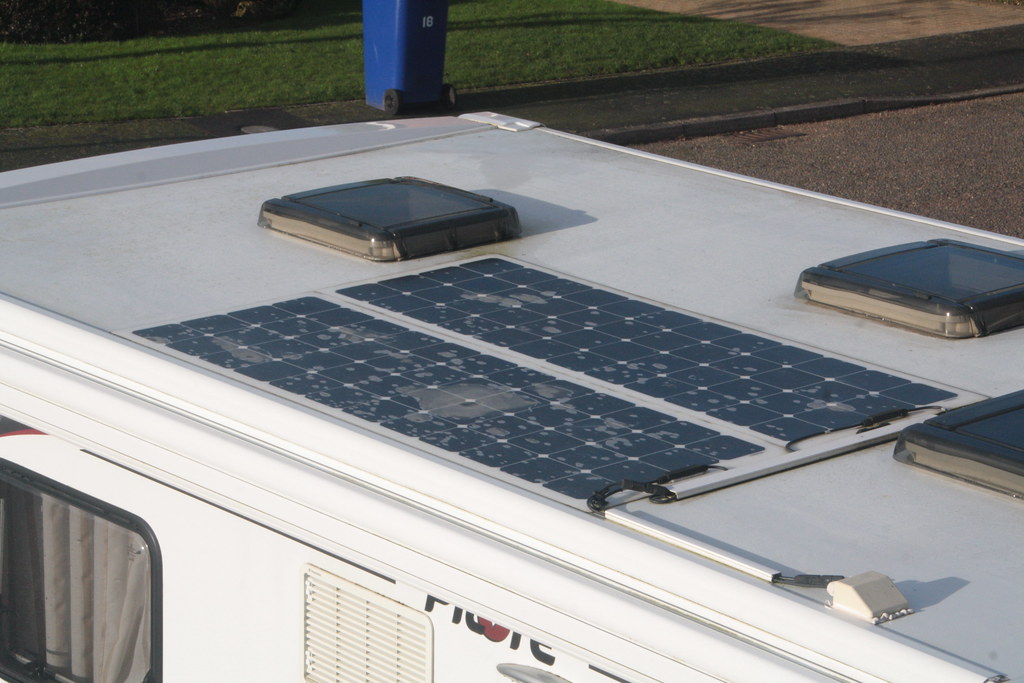
Solar panels are becoming increasingly popular for motorhomes and campervans. We decided to fit panels after a cold Easter break on a pitch without electrics. At the time I really had no idea how much solar would be good. In this blog I discuss how to make that decision, and also add some data to help you get an idea of how much power you might actually get from the system you fit.
If the terminology I’m using in this blog is confusing it might help for you to read my explanation – but possibly not!
Power usage
The most important factor is obviously your use of electrical power when off grid. You can get an approximation of this by listing all those devices you use, looking up their specifications and estimating your usage over a 24 hour period. You’ll need to do some research and interpretation, but it can be done. In general, moderate loads that are on for much of the time (like your heater fan or the fridge) are more important than high loads that are rarely used (such as the water pump).
Be careful about the units you’re working in – you’ll be measuring the energy use over 24 hours in either ampere hours (amp hours or Ah) or watt hours (Wh). It doesn’t matter which, but stick to one or the other. If you need to convert from one to the other, with a 12 volt system 1 ampere hour is equivalent to 12 watt hours (watts = volts x amps). As an example, consider a device that consumes an average current of 1 amp over 24 hours – therefore it will consume 24 Ah or 288 Wh of energy over a day. All simple enough in principle but fiddly in practice.
Power generated
I have found it much more difficult to get an estimate of the power that might be generated by a solar panel. I have a 300W system, but in most circumstances this system will not deliver that much power. The actual power delivered will depend on the strength and angle of the sun, the angle of the solar panel, any shading. But what is a reasonable figure?
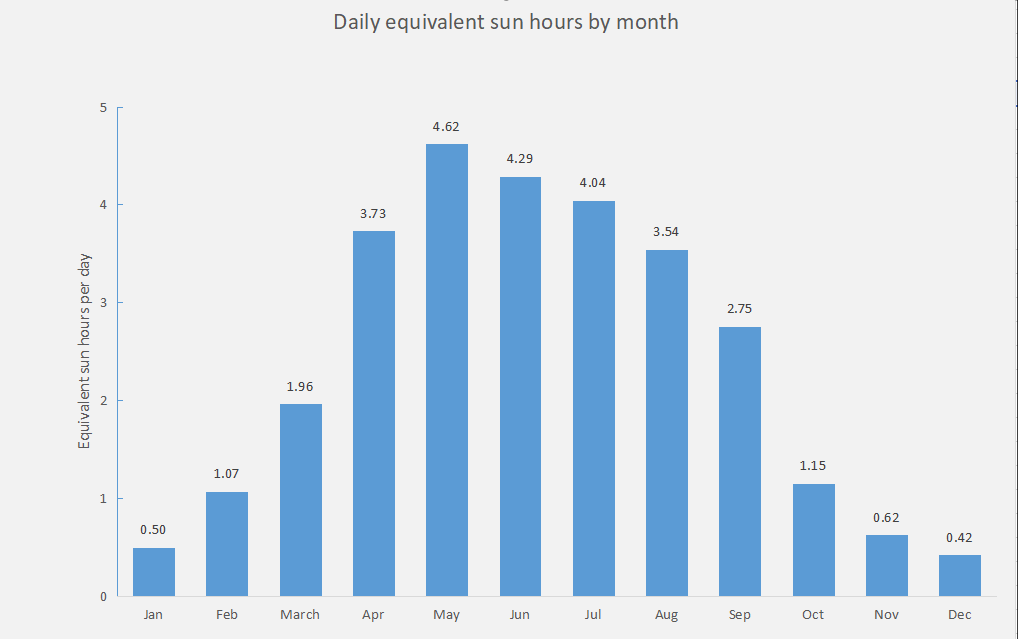
I realised that I can use the energy figures measured for the solar panels on my house to generate a reasonable estimate of what we might expect at UK latitudes. We have a pitched roof with our 4kW of panels split roughly evenly between east and west-facing. This is less than optimal, and possibly a good approximation for the many possible compromises of a solar panel on a motorhome roof.
Applying the figures
The result of my analysis is above. So how do we use it? I have a 300W solar panel on my motorhome. If I’m looking at camping in July, the figure for equivalent sun hours is about 4. This means that on an average day I can generate 1200Wh (4 x 300), which conveniently works out as 100Ah (1200 ÷ 12). Bear in mind that not all days are average – in July the best days delivered four times as much power as the worst.
But look at the winter months – we’re not getting much more than 10% of the July figures, so on average in January I will generate 150Wh (12Ah), and possibly as little as 30Wh (2.5aH) or less.
Some examples
Cold Easter
I bought my solar system after an Easter camping trip that turned very cold. After three days of using the heating system off-grid the battery was getting very low. What would happen if I repeated the trip now? Truma says that the heating consumes 1.1A on average, which will be 27Ah over the whole day (1.1 x 24). Adding lights and other consumers (perhaps we watch some TV), let’s assume we’ll more than double that – say 60Ah. Without the solar that is about as much as you’d want to take out of a single leisure battery of around 100Ah. The graph suggests more than 3 equivalent sun hours, so we will generate more than 900Wh or 75Ah on an average April day. So, on average we should be OK in April! We have the battery as a buffer for poor days, and can always economise a little if the light isn’t good.
Compressor fridges
Compressor fridges are increasingly popular, and with good reason, but I know a number of people who have been surprised by flat batteries when camping off-grid. The average current consumption of a good compressor refrigerator is around one or two amps, so the calculation is very similar to the one for heating – it’s not surprising that batteries go flat after two or three days. In the summer my 300W panel would have no trouble in keeping the fridge alive, and at the very least it would significantly improve endurance even in the winter – especially since the fridge will have less work to do. Of course, if you have a compressor fridge and diesel heating (which typically uses more electrical power than gas heating) you might still have some problems on dark winter days.
What about the battery?
A lot of articles on this topic say the first thing you should do is to add more battery capacity. I don’t agree. While this might solve the problem for some people, even if you double your battery capacity, it’s still a limited resource. You might last twice as long off grid, and that might be good enough for some people. But I’d far prefer to be able to replace what I’ve used every day, and therefore have infinite capacity. More battery is good, but for me the ability to recharge the battery I’ve got is better, so I’d spend the money on solar first – and did.
So what’s the answer?
If you always go somewhere you can hook up to mains power, don’t waste your money. You can survive the odd night or so without power. On the other hand, if you have a compressor fridge or a diesel heater and like to spend some time off grid, even if it’s only a couple of nights, then your battery really needs some help.
I know I’m not being very helpful with this, but the best answer I’ve heard is that you should fit as much solar power as you have space for, or can afford. You will have flexibility to cover unforeseen circumstances, the freedom to stay in lovely off-grid locations and you can harvest useful amounts of power in the winter. Then, once your roof is full of panels it might be worth considering increasing your battery capacity too.