
…not when you’re choosing solar panels for you motorhome
In another blog I considered the sizing of solar panels for a motorhome. In this blog I discuss some of the other issues that you might want to consider before fitting a system with fixed solar panels. You can read about portable solar panels here.
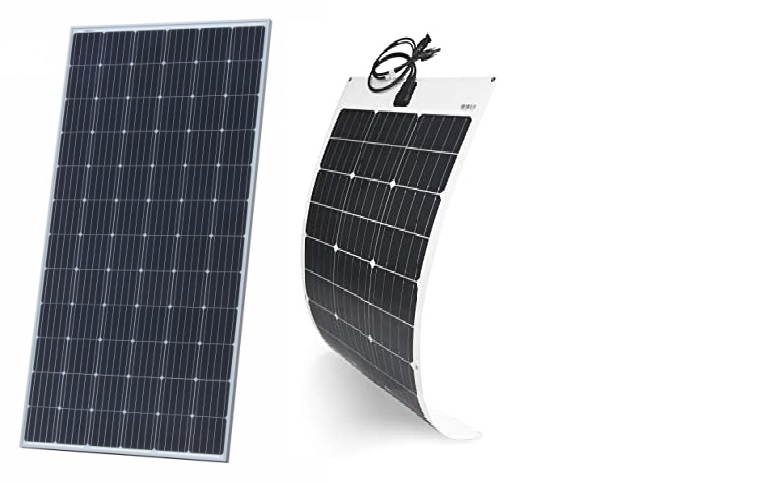
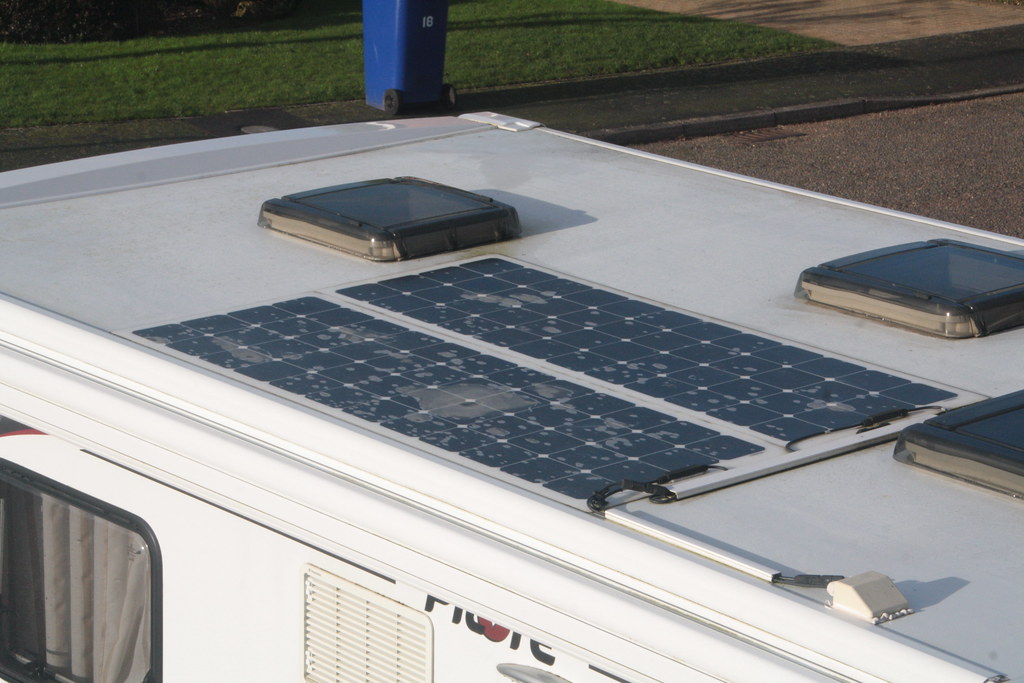
When we decided to fit solar panels to our motorhome I spoke to the dealer from whom I’d bought the motorhome. He told me that they normally fit flexible panels stuck directly to the roof. These are lighter and smaller than the alternative rigid panels (as you might have on your house). Since he was an agent for Pilote, familiar with the vehicle and the ideal location for the panels and the associated wiring, I took the easy way out and let him get on with it.
When I collected the motorhome everything was fitted neatly, and there wasn’t much to see from ground level. It turns out that the system only charges the leisure battery – my dealer thought it would charge the vehicle battery too, but that’s not really a problem for me. We’ve now been using the solar panels for a few seasons, so we’ve learnt a little about our system and its implications.
How could we have done it?
The alternative to our flexible panels would have been one or more rigid panels. Our motorhome has a very flat roof and no roof-bars, so fitting a rigid panel would have involved sticking mounting brackets to the roof. A rigid panel would stand clear of the roof, with potential for damage and wind noise. If you have a campervan or motorhome with a roof-rack, or mounting points for one, then fitting might be even simpler.
What have we learnt?
The system has worked well, and never caused any problems. Even with solar we have occasionally suffered from a low battery in extended bad weather (otherwise known as summer holiday), but at least there’s a way back. It’s good to know that normally even without a hook-up or running the engine, the battery will be fully charged by the evening, so that late night TV binge or hours on the PC blogging will be forgiven. And I know from other people’s experiences that solar is pretty well a must-have for those with compressor fridges.
Heat
I’d never really thought about this. Flexible panels stuck directly to the roof can make the inside of the roof surprisingly warm, despite all the insulation. We have one cupboard which is now not a good place to store a Mars Bar. There are three factors to this:
- solar panels naturally get warm as a part of their energy conversion process
- the panels are much darker than the roof, and therefore absorb more of the heat from the sun
- if you want to benefit from solar battery charging you tend to avoid the shade
Weight
A rigid panel is significantly heavier than a flexible panel of the same power. In practice this is not likely to be a critical factor.
Cost
Flexible panels are about twice the price of an equivalent rigid panel.
Controller
The Chinese MPPT controller works behind the scenes and appears to do a good job. The whole system is pretty unrewarding if you like tinkering with electronic gadgets, because it just gets on with the job. A controller from a company like Victron Energy might be more exciting, because you can link to your smartphone via Bluetooth, watch all those lovely electrons being captured, and monitor your battery state. That might help if your usage is marginal at any time, but in truth “it just works” is perfectly acceptable.
Durability
I can’t really comment on durability – yet. Our panels are now looking as though they’ve spent too long on the beach, but still seem to be working fine. Flexible panels are unlikely to be physically damaged by getting stood on, or by falling branches – a rigid panel is more fragile, but sat in its frame it’s still a pretty robust piece of kit.
Should anything go wrong, I’ve heard that it’s not a pleasant job to remove a stuck on flexible panel, whereas replacing a rigid panel mounted on a bracket should be trivial.
Summary
The system has enhanced our usage of the van and overcome charge anxiety, particularly for longer stays and out of peak season. The hot cupboard is a bit of an issue when the weather is sunny (although I guess it would be good for bread making). Otherwise, now we’ve spent the money, there are no real downsides for us. If one of your motivations is to maintain your starter battery whilst in storage, you will need to check out the choice of controller and the arrangement of the wiring so that both batteries can be charged appropriately.