I have a problem. Actually I have a lot of problems, but the one that’s relevant right now is that I studied engineering, so things like amps and volts and watts don’t really bother me.
V = IR seems entirely reasonable. Even v2 = u2 + 2as is fine, because it’s Newtonian mechanics. I do come relatively unstuck when Einstein gets involved and nothing is quite like you think it is, and I get even more uncertain when Heisenberg joins in (that’s a very bad physics joke).
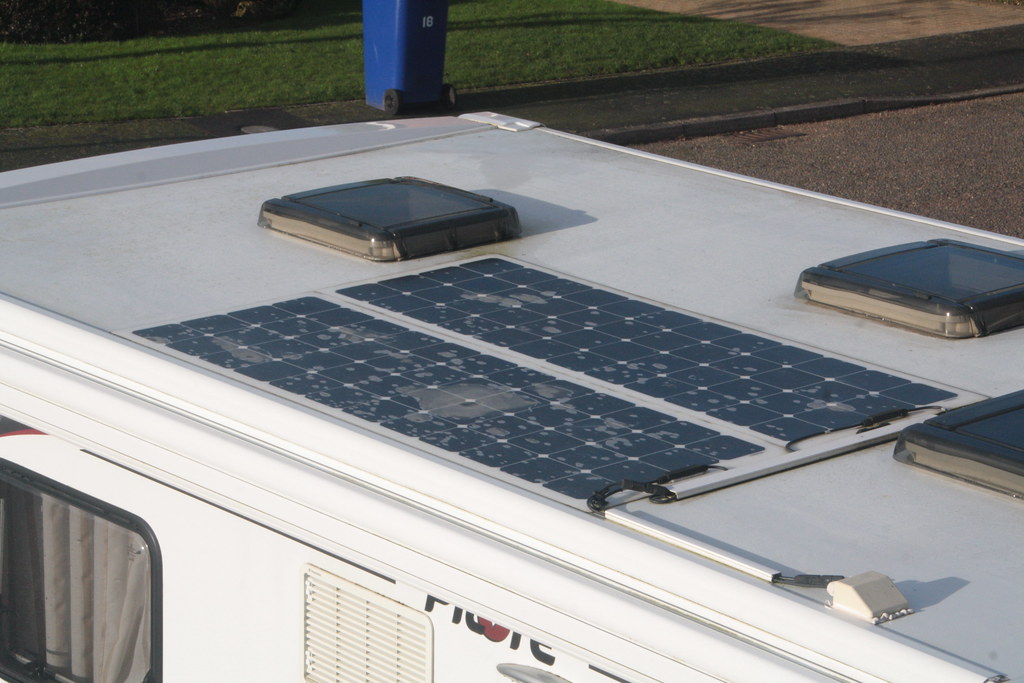
But I digress. When I was writing my blog about solar panels for motorhomes, I realised that my terminology might confuse some of my readers – if indeed I have any. So I thought I would put together a little explanation of some of the terms I used in that blog and attempt to use a plumbing analogy to explain some of the logic.
The plumbing analogy
Water tank
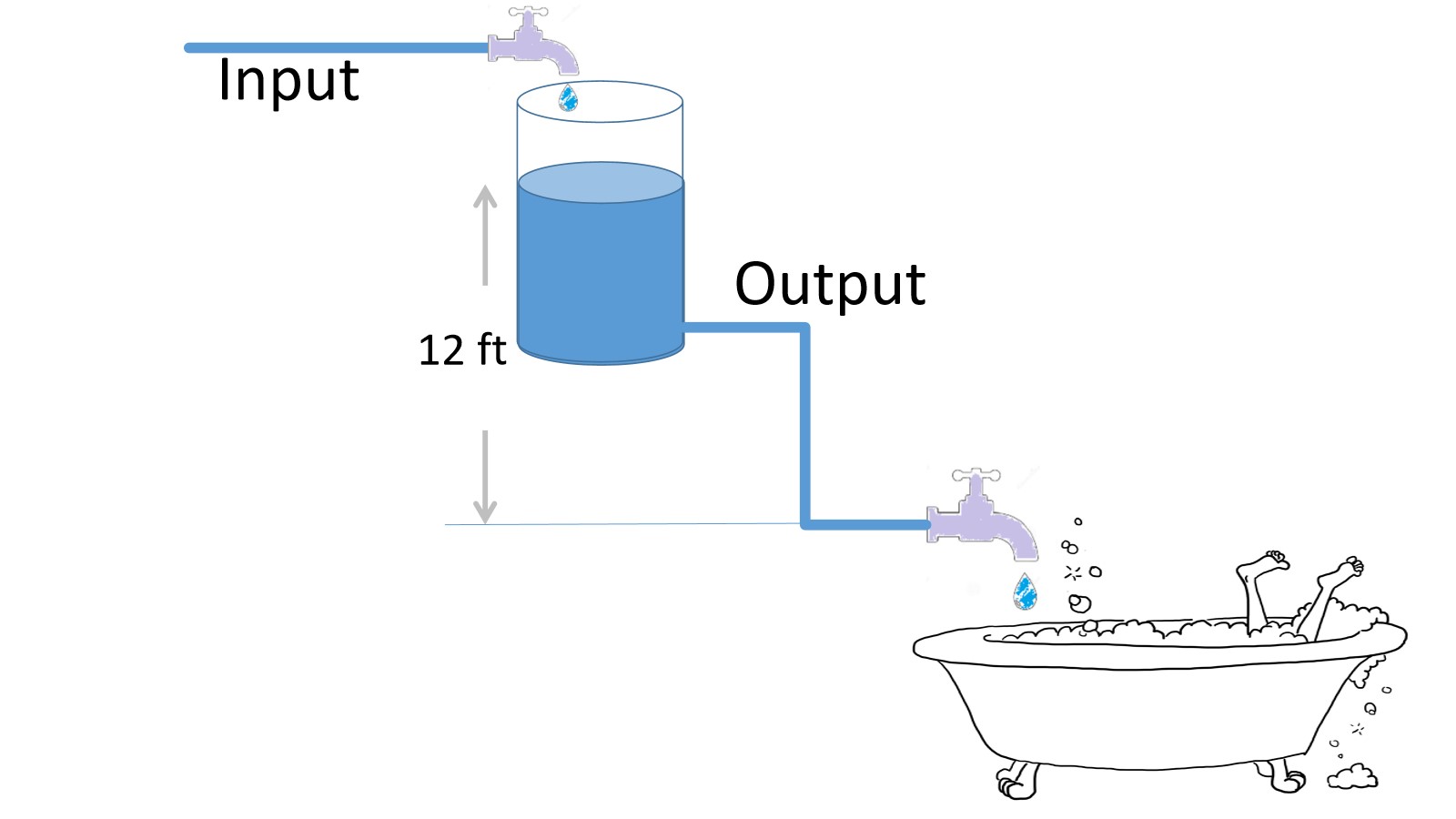
The diagram above shows a bath filled from a water tank above it. That water tank in turn can be filled from a pipe marked “Input” which is fed by a stream. There is a tap on the input pipe which can be turned off to stop the tank overflowing. The water level in the tank is 12 ft above the bath tap. The tank can hold 100 gallons of water.
This water tank is equivalent to the battery in a motorhome electrical system.
I’m worried already that I’m just confusing the issue
Bath
The bath consumes the water from the tank, fed through the pipe marked “output”. The flow of water into the bath is controlled by the tap.
Terminology
Volts (V)
Electrical volts are equivalent to pressure in our little plumbing system. The pressure at the bath tap is determined by the height of the water in the tank above, which is 12 ft when the tank is full. If the tank was higher the water would come out more quickly, and vice versa. The effect you might notice with your motorhome is that when the voltage is low things run sluggishly.
Please don’t look too closely at my logic, especially if you understand these things. It’s falling apart already, I know. It seemed so simple when I started!
Amps (A)
Amps are the measure of electrical current (or the flow of electrons through the wire). In our plumbing model, the current is rate at which the water is flowing. Just to make it more confusing amps is short for ampères, which is usually spelt without the grave (down-slanty) accent because it’s French and no-one knows how to type one.
Watts (W)
A watt is a unit of power. My analogy falls apart at this point – but it would work if you were playing with a water-wheel under the bath tap. If you ran more water through the tap the water wheel would go faster and generate more power. If you know the voltage (around 12V when you’re running from the battery of a motorhome) and you know the current, you multiply volts x amps to give you the power in watts. So that 5W LED is consuming a current of around 0.4A (5 ÷ 12).
I do hope I’ve got my arithmetic right. I’d look such a fool if I divide when I’m meant to multiply
Amp hours (Ah)
You will have seen this in discussions of batteries. This is a measure of the capacity of a battery. It’s equivalent to the capacity of the tank in our little diagram. When you’re off-grid it’s all you have available to power your electrical equipment. Our tank holds 100 gallons. Your battery may hold 100Ah or a little more. Without any means of refilling, when it’s gone it’s gone. You can recharge your battery from a mains hookup, from the vehicle alternator when the engine is running, from a generator if you don’t want any friends, or from solar panels.
If our bath holds 80 gallons, we’ll be OK for one bath if the tank was full when we started. Similarly if your 100Ah battery was fully charged and your requirement while off grid was for 80Ah it would be able to supply your needs. This could mean delivering a current of 1A for 80 hours, or a current of 80A for one hour, or any other combination which gives 80 when multiplied together. In theory your battery would power that 5W LED for about 10 days!
Watt hours (Wh)
Watt hours are another (slightly more scientific) way of measuring electrical energy. When we use watt hours we’re taking account of the voltage, so our 12V battery of 100Ah contains 1200Wh of energy (100 x 12). This is 1.2kW hours, or 1.2 units of electricity, as your supplier would describe it. Your battery can supply enormous currents, but working at only 12V (as compared to 230V mains electricity) that still doesn’t add up to a lot of energy.
Note to self: Just don’t mention AC and DC – that would be the final straw
What does solar do for us?
When the sun shines on your solar panel, it’s the equivalent of turning on the “Input” tap. The tank (or your battery) starts to fill. So if the water runs into the tank for long enough with a high enough flow rate, your tank level will be replenished and you’ll be ready for another bath. If this happens every day, it will look as though you have an unlimited water supply. As an added bonus, you can run your bath quickly, even if the input is quite slow, or temporarily unavailable. And the same with your motorhome electrical system – you can draw 100A from the battery (for a short time) just as long as it will get refilled over a longer period. That 100A might sound a lot, but you really want that hair drier, don’t you?
Of course, you don’t want the tank to overflow – that’s what the tap is for. This is the equivalent of the solar controller in your electrical system. It will automatically control the “tap” to top up your battery as fast as possible, and stop when it’s full.
The trick with the solar charging system is to achieve a balance between the input (from the panels) and the output through your electrical devices, not over the short term, but aggregated over 24 hours – you’re always hoping the sun will come up tomorrow (as it has every day so far in my life), and 24 hours is the horizon for new solar energy.