Much of what I wrote in my earlier blog also applies to portable panels – in general, from the operational point of view the bigger the better, but with portable panels there is the downside of storage when the panel is not deployed. A degree of compromise is required.
Advantages
Cheaper and simpler to install – a decent portable panel will have a built-in controller so you can just connect it to the leisure battery (or indeed the engine battery if you want to charge that) directly via crocodile clips or a convenient socket.
Can be placed in the sun even if you’re parked in the shade – good for keeping the van cool, or if you have no choice of pitch. You can also rotate it as the sun goes round to maximise efficiency.
Disadvantages
Storage space – by definition a decent panel is quite large, but there’s often a corner somewhere to hide it away.
Cables across the pitch
Risk of theft – it’s portable, so it’s designed to be easy to walk away with. You can chain it to the van, but then you lose some of the flexibility
Options for when your van is parked up
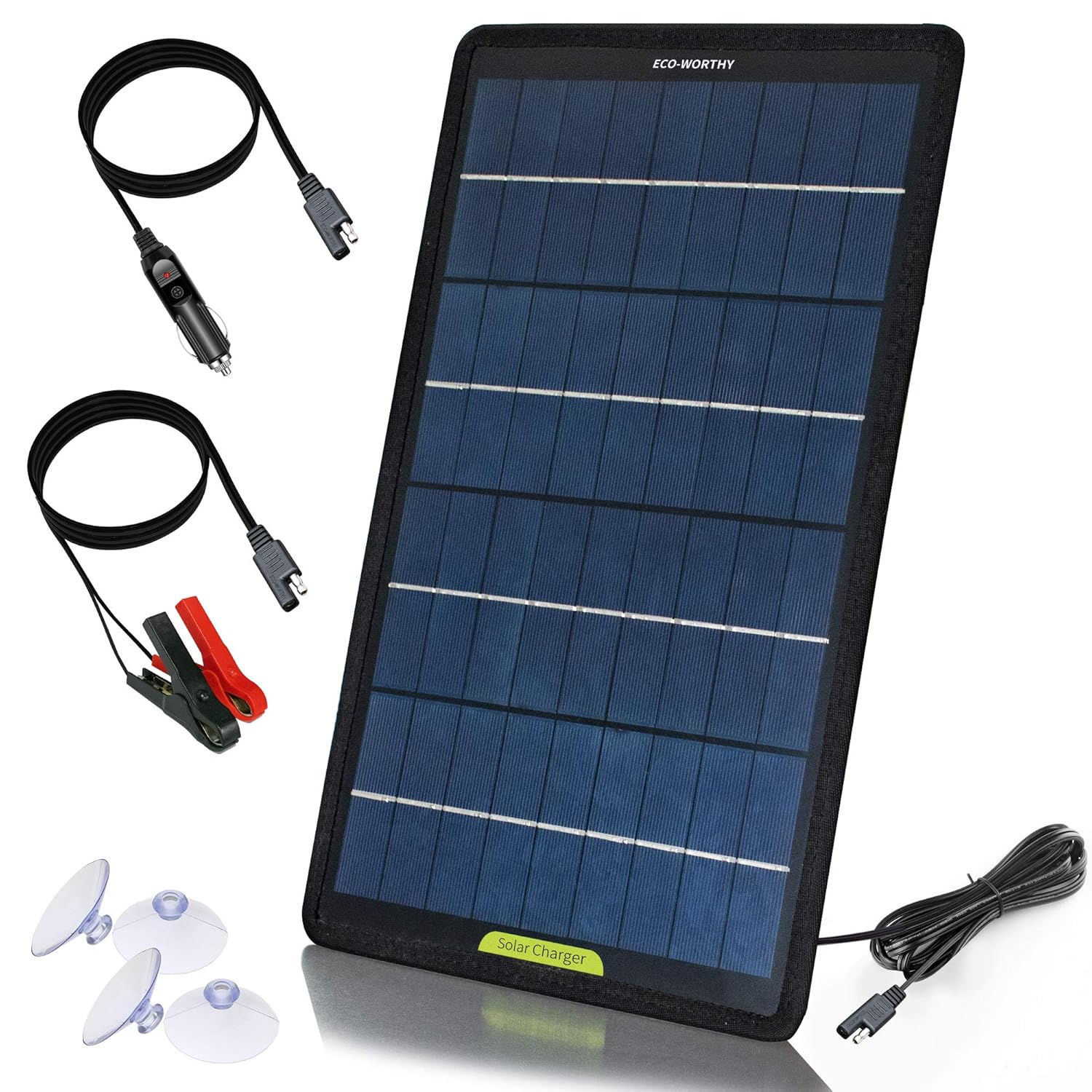
A battery maintainer
As another variation, to keep batteries alive while the van is in storage, you could consider a battery maintainer. Something as pictured above should keep either your leisure battery or your vehicle battery alive if you can locate it in a window that receives a reasonable amount of light. It wouldn’t provide enough power to be useful while you’re camping, but will do a good job replenishing battery leakage whilst idle. I’d go for a rated power of something like 10W.
…not when you’re choosing solar panels for you motorhome
In another blog I considered the sizing of solar panels for a motorhome. In this blog I discuss some of the other issues that you might want to consider before fitting a system with fixed solar panels. You can read about portable solar panels here.
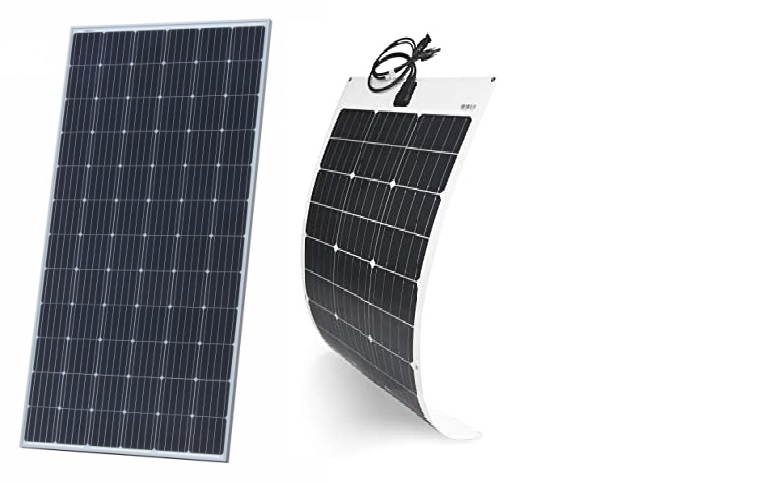
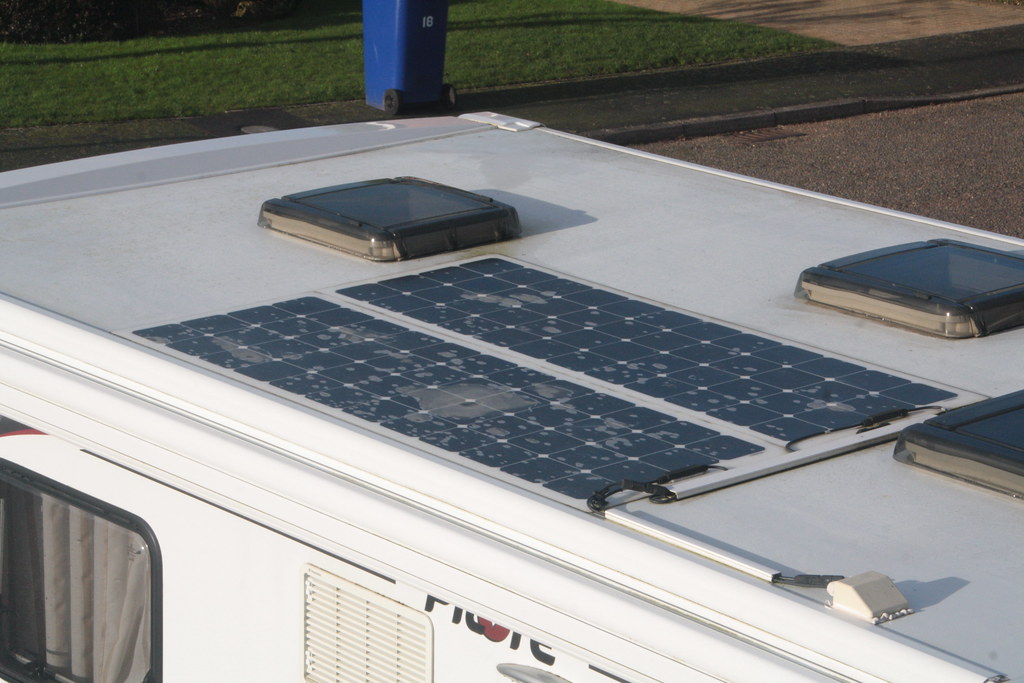
When we decided to fit solar panels to our motorhome I spoke to the dealer from whom I’d bought the motorhome. He told me that they normally fit flexible panels stuck directly to the roof. These are lighter and smaller than the alternative rigid panels (as you might have on your house). Since he was an agent for Pilote, familiar with the vehicle and the ideal location for the panels and the associated wiring, I took the easy way out and let him get on with it.
When I collected the motorhome everything was fitted neatly, and there wasn’t much to see from ground level. It turns out that the system only charges the leisure battery – my dealer thought it would charge the vehicle battery too, but that’s not really a problem for me. We’ve now been using the solar panels for a few seasons, so we’ve learnt a little about our system and its implications.
How could we have done it?
The alternative to our flexible panels would have been one or more rigid panels. Our motorhome has a very flat roof and no roof-bars, so fitting a rigid panel would have involved sticking mounting brackets to the roof. A rigid panel would stand clear of the roof, with potential for damage and wind noise. If you have a campervan or motorhome with a roof-rack, or mounting points for one, then fitting might be even simpler.
What have we learnt?
The system has worked well, and never caused any problems. Even with solar we have occasionally suffered from a low battery in extended bad weather (otherwise known as summer holiday), but at least there’s a way back. It’s good to know that normally even without a hook-up or running the engine, the battery will be fully charged by the evening, so that late night TV binge or hours on the PC blogging will be forgiven. And I know from other people’s experiences that solar is pretty well a must-have for those with compressor fridges.
Our 300W installation. The cable goes straight down to a connection point in the wiring loom
Heat
I’d never really thought about this. Flexible panels stuck directly to the roof can make the inside of the roof surprisingly warm, despite all the insulation. We have one cupboard which is now not a good place to store a Mars Bar. There are three factors to this:
solar panels naturally get warm as a part of their energy conversion process
the panels are much darker than the roof, and therefore absorb more of the heat from the sun
if you want to benefit from solar battery charging you tend to avoid the shade
Weight
A rigid panel is significantly heavier than a flexible panel of the same power. In practice this is not likely to be a critical factor.
Cost
Flexible panels are about twice the price of an equivalent rigid panel.
Controller
The Chinese MPPT controller works behind the scenes and appears to do a good job. The whole system is pretty unrewarding if you like tinkering with electronic gadgets, because it just gets on with the job. A controller from a company like Victron Energy might be more exciting, because you can link to your smartphone via Bluetooth, watch all those lovely electrons being captured, and monitor your battery state. That might help if your usage is marginal at any time, but in truth “it just works” is perfectly acceptable.
Durability
I can’t really comment on durability – yet. Our panels are now looking as though they’ve spent too long on the beach, but still seem to be working fine. Flexible panels are unlikely to be physically damaged by getting stood on, or by falling branches – a rigid panel is more fragile, but sat in its frame it’s still a pretty robust piece of kit.
Should anything go wrong, I’ve heard that it’s not a pleasant job to remove a stuck on flexible panel, whereas replacing a rigid panel mounted on a bracket should be trivial.
Summary
The system has enhanced our usage of the van and overcome charge anxiety, particularly for longer stays and out of peak season. The hot cupboard is a bit of an issue when the weather is sunny (although I guess it would be good for bread making). Otherwise, now we’ve spent the money, there are no real downsides for us. If one of your motivations is to maintain your starter battery whilst in storage, you will need to check out the choice of controller and the arrangement of the wiring so that both batteries can be charged appropriately.
I have a problem. Actually I have a lot of problems, but the one that’s relevant right now is that I studied engineering, so things like amps and volts and watts don’t really bother me.
V = IR seems entirely reasonable. Even v2 = u2 + 2as is fine, because it’s Newtonian mechanics. I do come relatively unstuck when Einstein gets involved and nothing is quite like you think it is, and I get even more uncertain when Heisenberg joins in (that’s a very bad physics joke).
But I digress. When I was writing my blog about solar panels for motorhomes, I realised that my terminology might confuse some of my readers – if indeed I have any. So I thought I would put together a little explanation of some of the terms I used in that blog and attempt to use a plumbing analogy to explain some of the logic.
The plumbing analogy
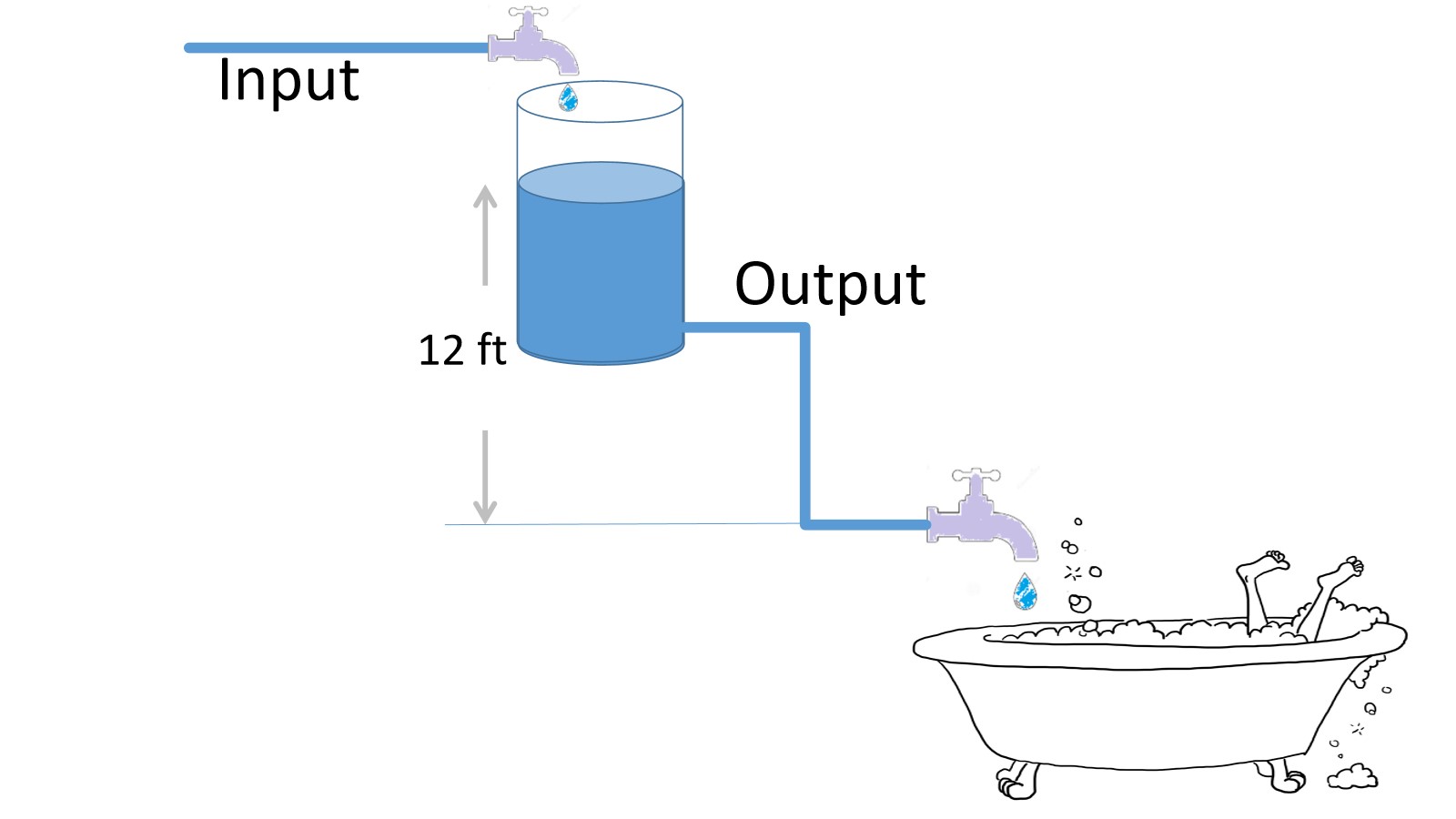
Water tank
The diagram above shows a bath filled from a water tank above it. That water tank in turn can be filled from a pipe marked “Input” which is fed by a stream. There is a tap on the input pipe which can be turned off to stop the tank overflowing. The water level in the tank is 12 ft above the bath tap. The tank can hold 100 gallons of water.
This water tank is equivalent to the battery in a motorhome electrical system.
I’m worried already that I’m just confusing the issue
Bath
The bath consumes the water from the tank, fed through the pipe marked “output”. The flow of water into the bath is controlled by the tap.
Terminology
Volts (V)
Electrical volts are equivalent to pressure in our little plumbing system. The pressure at the bath tap is determined by the height of the water in the tank above, which is 12 ft when the tank is full. If the tank was higher the water would come out more quickly, and vice versa. The effect you might notice with your motorhome is that when the voltage is low things run sluggishly.
Please don’t look too closely at my logic, especially if you understand these things. It’s falling apart already, I know. It seemed so simple when I started!
Amps (A)
Amps are the measure of electrical current (or the flow of electrons through the wire). In our plumbing model, the current is rate at which the water is flowing. Just to make it more confusing amps is short for ampères, which is usually spelt without the grave (down-slanty) accent because it’s French and no-one knows how to type one.
Watts (W)
A watt is a unit of power. My analogy falls apart at this point – but it would work if you were playing with a water-wheel under the bath tap. If you ran more water through the tap the water wheel would go faster and generate more power. If you know the voltage (around 12V when you’re running from the battery of a motorhome) and you know the current, you multiply volts x amps to give you the power in watts. So that 5W LED is consuming a current of around 0.4A (5 ÷ 12).
I do hope I’ve got my arithmetic right. I’d look such a fool if I divide when I’m meant to multiply
Amp hours (Ah)
You will have seen this in discussions of batteries. This is a measure of the capacity of a battery. It’s equivalent to the capacity of the tank in our little diagram. When you’re off-grid it’s all you have available to power your electrical equipment. Our tank holds 100 gallons. Your battery may hold 100Ah or a little more. Without any means of refilling, when it’s gone it’s gone. You can recharge your battery from a mains hookup, from the vehicle alternator when the engine is running, from a generator if you don’t want any friends, or from solar panels.
If our bath holds 80 gallons, we’ll be OK for one bath if the tank was full when we started. Similarly if your 100Ah battery was fully charged and your requirement while off grid was for 80Ah it would be able to supply your needs. This could mean delivering a current of 1A for 80 hours, or a current of 80A for one hour, or any other combination which gives 80 when multiplied together. In theory your battery would power that 5W LED for about 10 days!
Watt hours (Wh)
Watt hours are another (slightly more scientific) way of measuring electrical energy. When we use watt hours we’re taking account of the voltage, so our 12V battery of 100Ah contains 1200Wh of energy (100 x 12). This is 1.2kW hours, or 1.2 units of electricity, as your supplier would describe it. Your battery can supply enormous currents, but working at only 12V (as compared to 230V mains electricity) that still doesn’t add up to a lot of energy.
Note to self: Just don’t mention AC and DC – that would be the final straw
What does solar do for us?
When the sun shines on your solar panel, it’s the equivalent of turning on the “Input” tap. The tank (or your battery) starts to fill. So if the water runs into the tank for long enough with a high enough flow rate, your tank level will be replenished and you’ll be ready for another bath. If this happens every day, it will look as though you have an unlimited water supply. As an added bonus, you can run your bath quickly, even if the input is quite slow, or temporarily unavailable. And the same with your motorhome electrical system – you can draw 100A from the battery (for a short time) just as long as it will get refilled over a longer period. That 100A might sound a lot, but you really want that hair drier, don’t you?
Of course, you don’t want the tank to overflow – that’s what the tap is for. This is the equivalent of the solar controller in your electrical system. It will automatically control the “tap” to top up your battery as fast as possible, and stop when it’s full.
The trick with the solar charging system is to achieve a balance between the input (from the panels) and the output through your electrical devices, not over the short term, but aggregated over 24 hours – you’re always hoping the sun will come up tomorrow (as it has every day so far in my life), and 24 hours is the horizon for new solar energy.
Solar panels are becoming increasingly popular for motorhomes and campervans. We decided to fit panels after a cold Easter break on a pitch without electrics. At the time I really had no idea how much solar would be good. In this blog I discuss how to make that decision, and also add some data to help you get an idea of how much power you might actually get from the system you fit.
If the terminology I’m using in this blog is confusing it might help for you to read my explanation – but possibly not!
Power usage
The most important factor is obviously your use of electrical power when off grid. You can get an approximation of this by listing all those devices you use, looking up their specifications and estimating your usage over a 24 hour period. You’ll need to do some research and interpretation, but it can be done. In general, moderate loads that are on for much of the time (like your heater fan or the fridge) are more important than high loads that are rarely used (such as the water pump).
Be careful about the units you’re working in – you’ll be measuring the energy use over 24 hours in either ampere hours (amp hours or Ah) or watt hours (Wh). It doesn’t matter which, but stick to one or the other. If you need to convert from one to the other, with a 12 volt system 1 ampere hour is equivalent to 12 watt hours (watts = volts x amps). As an example, consider a device that consumes an average current of 1 amp over 24 hours – therefore it will consume 24 Ah or 288 Wh of energy over a day. All simple enough in principle but fiddly in practice.
Power generated
I have found it much more difficult to get an estimate of the power that might be generated by a solar panel. I have a 300W system, but in most circumstances this system will not deliver that much power. The actual power delivered will depend on the strength and angle of the sun, the angle of the solar panel, any shading. But what is a reasonable figure?
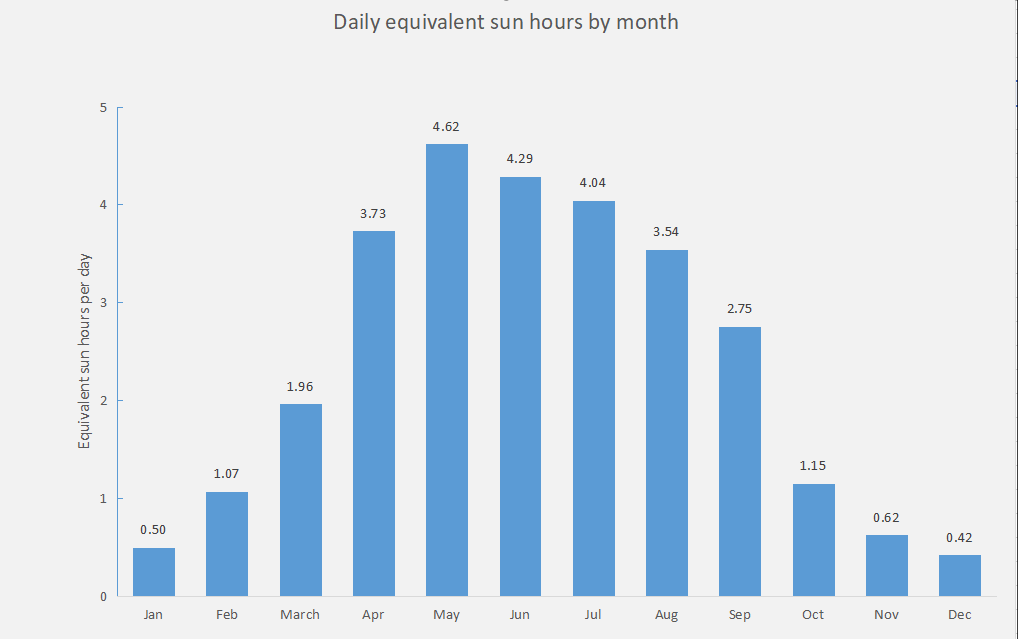
I realised that I can use the energy figures measured for the solar panels on my house to generate a reasonable estimate of what we might expect at UK latitudes. We have a pitched roof with our 4kW of panels split roughly evenly between east and west-facing. This is less than optimal, and possibly a good approximation for the many possible compromises of a solar panel on a motorhome roof.
Equivalent sun hours by month
Applying the figures
The result of my analysis is above. So how do we use it? I have a 300W solar panel on my motorhome. If I’m looking at camping in July, the figure for equivalent sun hours is about 4. This means that on an average day I can generate 1200Wh (4 x 300), which conveniently works out as 100Ah (1200 ÷ 12). Bear in mind that not all days are average – in July the best days delivered four times as much power as the worst.
But look at the winter months – we’re not getting much more than 10% of the July figures, so on average in January I will generate 150Wh (12Ah), and possibly as little as 30Wh (2.5aH) or less.
Some examples
Cold Easter
I bought my solar system after an Easter camping trip that turned very cold. After three days of using the heating system off-grid the battery was getting very low. What would happen if I repeated the trip now? Truma says that the heating consumes 1.1A on average, which will be 27Ah over the whole day (1.1 x 24). Adding lights and other consumers (perhaps we watch some TV), let’s assume we’ll more than double that – say 60Ah. Without the solar that is about as much as you’d want to take out of a single leisure battery of around 100Ah. The graph suggests more than 3 equivalent sun hours, so we will generate more than 900Wh or 75Ah on an average April day. So, on average we should be OK in April! We have the battery as a buffer for poor days, and can always economise a little if the light isn’t good.
Compressor fridges
Compressor fridges are increasingly popular, and with good reason, but I know a number of people who have been surprised by flat batteries when camping off-grid. The average current consumption of a good compressor refrigerator is around one or two amps, so the calculation is very similar to the one for heating – it’s not surprising that batteries go flat after two or three days. In the summer my 300W panel would have no trouble in keeping the fridge alive, and at the very least it would significantly improve endurance even in the winter – especially since the fridge will have less work to do. Of course, if you have a compressor fridge and diesel heating (which typically uses more electrical power than gas heating) you might still have some problems on dark winter days.
What about the battery?
A lot of articles on this topic say the first thing you should do is to add more battery capacity. I don’t agree. While this might solve the problem for some people, even if you double your battery capacity, it’s still a limited resource. You might last twice as long off grid, and that might be good enough for some people. But I’d far prefer to be able to replace what I’ve used every day, and therefore have infinite capacity. More battery is good, but for me the ability to recharge the battery I’ve got is better, so I’d spend the money on solar first – and did.
So what’s the answer?
If you always go somewhere you can hook up to mains power, don’t waste your money. You can survive the odd night or so without power. On the other hand, if you have a compressor fridge or a diesel heater and like to spend some time off grid, even if it’s only a couple of nights, then your battery really needs some help.
I know I’m not being very helpful with this, but the best answer I’ve heard is that you should fit as much solar power as you have space for, or can afford. You will have flexibility to cover unforeseen circumstances, the freedom to stay in lovely off-grid locations and you can harvest useful amounts of power in the winter. Then, once your roof is full of panels it might be worth considering increasing your battery capacity too.