I recently wrote about the possibilities and limitations of electric vehicles as campervans – http://www.cliffdive.co.uk/plug-and-play/. My conclusion was that while there are some exciting possibilities for the future, the base vehicles are not yet suited for the long journeys that we typically make with our leisure vehicles. Electric vans are optimised for “last mile” deliveries for which they only require a range of 100 miles or less.
But there is a unique offering in the van marketplace with the Ford Transit Custom plug-in hybrid (PHEV). This is (at the time of writing, and to the best of my knowledge) the only van offered with a plug-in hybrid drive train.
How does it work?
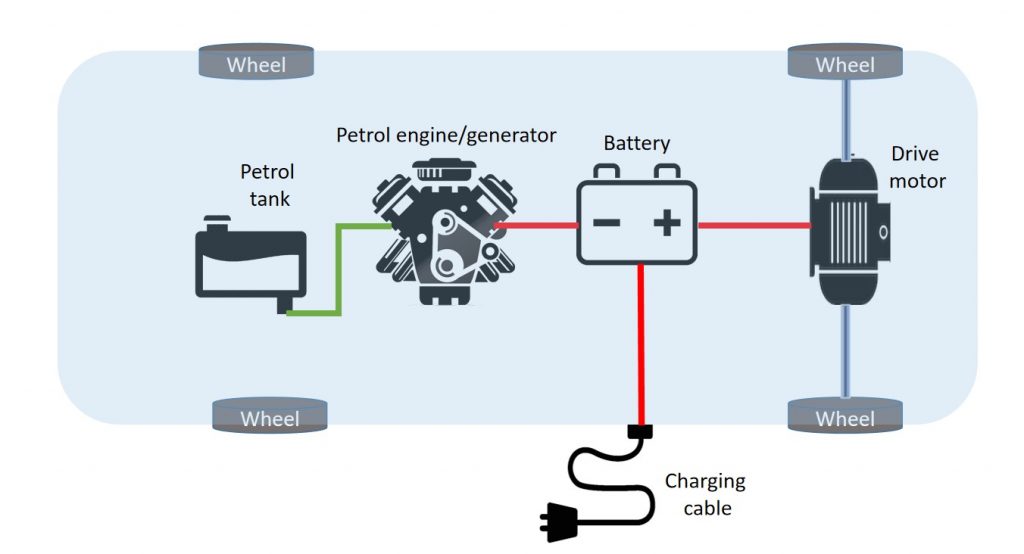
The range-extender architecture of the Ford Transit Custom plug-in hydrid
The van is always driven by its electric motor. Its battery can be charged from a normal domestic socket or a roadside charging point, just like a full EV, and it can do around 30 miles under battery power alone. Charging would take less than five hours via a standard domestic socket and much less at a charging point. But if you want to go further, there’s a petrol engine hidden in there too which can replenish the battery as you drive, giving you a total range of around 300 miles between fill-ups (which of course can be electricity or petrol). The driver can choose various modes of operation from full electric driving to battery charging mode (charging the battery while driving), or the system can work automatically, deciding the best mode at any time.
Would it work as a campervan?
The short answer is “yes”. Unlike the full-electric vans available right now, the range extender design offers an essentially infinite driving range without resort to a charging station. Your touring can take advantage of the full-electric capability for access to increasingly restricted city centres, and you can make quiet exits from campsites.
As discussed in my blog about full-EV vans, if Ford were to offer access to the traction battery, its 13kWh capacity would be more than enough to replace the conventional leisure battery, allowing a gas-free conversion, with electrical power used for cooking and the fridge. Unlike the full EV vans, you’d be fine for off-grid adventures too, because the range extender engine will recharge the battery without plugging into a mains outlet. All you need is petrol. And even better, you can stay cosy while camping using petrol (or gasoline if you’re American) for your space heating.
All in all this would make an excellent base for a conversion…
…if you don’t mind paying an additional £15,000 or so for all the technology.
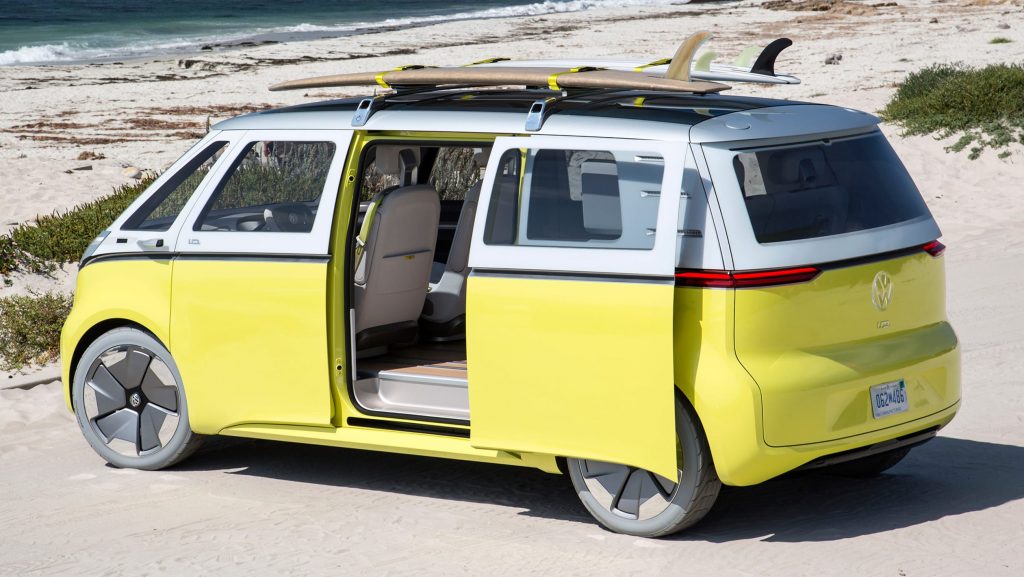
The I.D. Buzz Microbus – at the moment it’s a concept vehicle, but VW say it will enter production
For reasons best known to its secret algorithms, Facebook recently offered me an advert for the VW e-Transporter. It got me thinking. After all, the Transporter has been pretty ubiquitous as a campervan platform. Just how would an electric vehicle stack up as a camper van?
I’ve been enjoying campervans and motorhomes for 35 years. Of course, all of these have been powered by internal combustion engines – two of them had petrol engines, and two were diesels. But in a few years we won’t have internal combustion engines. There is already a growing movement towards electric vehicles. Would I still be able to enjoy van life with an electric vehicle? To answer this question I will create a hypothetical vehicle based on currently feasible technology.
My electric dream van
Since this thought process was inspired by the Volkswagen Transporter, let’s consider a van based on a Transporter sized vehicle – this is after all the classic campervan. One of the surprising features of modern electric vehicles is that performance can be very brisk, so we don’t need to worry about the power of the motor – 100bhp+ is easy, and I’d be happy with that. The battery is the key component – for the purposes of this flight of fancy, we will assume a battery of 100kWh. This is entirely feasible (if rather expensive) today. It would give a range of more than 200 miles. These figures are broadly in line with the I.D. Buzz concept vehicle pictured at the top of this page.
The conversion
There’s really no need to change the classic VW campervan layout – rock and roll bed in the rear, and kitchen along the side opposite the sliding door. But we can take advantage of the energy source to make some changes in services. Current campervans with internal combustion engines carry a leisure battery (typically lead-acid but increasingly lithium) to power the electrical system, including internal lights, water pump, TV, phone chargers and often the fridge. This leisure battery is typically around 100Ah (ampere hours) which translates to 1.2kWh. This is negligible compared to the 100kWh traction battery of our dream machine, so let’s be adventurous, throw away the leisure battery, and tap into the big traction battery for our internal systems. The effect on range will be tiny, and we’ve saved a bit of space and eliminated one of the worries of off-grid camping – a flat leisure battery.
Most campervans use gas for cooking and sometimes for the fridge, but with the amount of energy now available we can build a gas-free van, which helps to simplify the design, save space and increase safety and convenience. An induction hob would make a very small impact on the battery, and we could have an inverter to power 240V sockets for the coffee machine, hair dryer or electric bikes. The only real challenge to our all-electric life is space heating in the winter, but if we start with a full battery we’re fine for a few days of off-grid electrical heating. At the moment, with a gas heater in a camper van you’d have a similar limitation – our 100kWh of battery energy is equivalent to 7kg of gas, which is a typical amount for a campervan to carry.
If we’re using electricity for space heating while on site, it would make sense (technically, even if not in terms of initial cost) to fit an air-conditioning unit that could not only deliver more efficient heating by running as a heat pump, but also keep you cool in warmer climes. Our huge battery capacity makes that off-grid campervan air-con a possibility, where today it’s possible only for giant luxury motorhomes with noisy generators.
Charging
This is the elephant in the room for all electric vehicles. We can obviously tap into the growing EV charging network. Rapid chargers can deliver 50kW or more, so we could charge from empty in a couple of hours. Rapid chargers will be increasingly available as electric vehicles gain popularity.
At the other extreme we can plug into a normal electrical outlet when we’re at home or on a campsite. A domestic 3kW outlet would take more than 33 hours to charge from empty. That’s fine – you will leave the campsite with a full battery after a couple of nights camping.
At the moment solar power is popular for keeping a campervan leisure battery topped up. For a campervan a 300W solar charger is feasible, producing maybe 1kWh per day (it depends very much on the weather and time of year). This would be sufficient to replenish energy used for camping, but it would take 3 months to charge the battery from flat, so solar is probably no longer useful unless you’re intending long term autonomy in one location.
Touring
How would all this work in real life? Sometimes touring involves driving very short distances, and seeing the sights but there are travelling days which will be more demanding. When we’re on holiday we typically travel for 2 or 3 hours before lunch. This will be 100 miles or so. If our lunch stop (or shopping or sight-seeing stop) can be at a rapid charger, the battery would be replenished in an hour or so. It’s actually more comfortable doing this with a campervan than a car, because you have all of your facilities with you. Coffee, toilet, food – they’re all on board. After lunch we will do another 2 or 3 hours – we’ll have plenty of range for this, and plenty of energy remaining for camping needs if we’re off-grid.
With our 100kWh battery, it wouldn’t have been a problem if we hadn’t met a charger until afternoon tea, or we could exploit our full range without en-route charging if we’re heading for a few days on camp site with a mains connection for slow charging.
Pick a platform
Could we do it today? Here are a couple of electric vans you could buy right now. There are others with similar specifications, but for different reasons, these are probably the two most interesting examples. Let’s see how they match up to my dream.
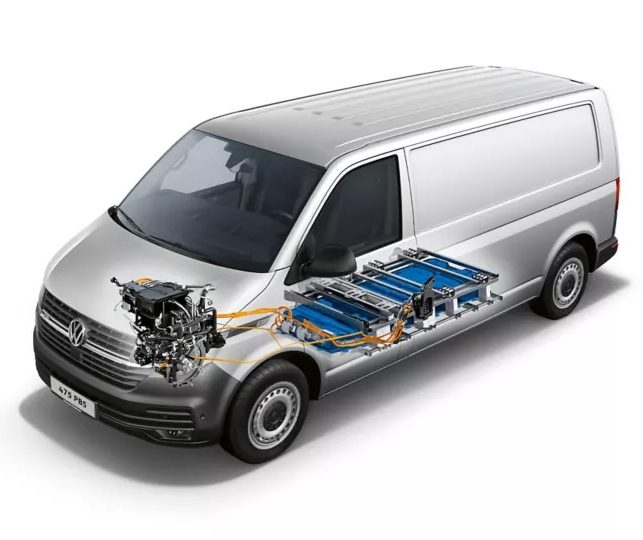
Volkswagen e-Transporter
There’s no doubt that the physical package for the VW Transporter works well as a campervan. Performance is fine – 99mph and 0-62mph in 17.4 seconds. But with a 33.7 kWh battery the range is just 82 miles. There has been talk of double battery version, with 77.6 kWh. This would of course roughly double the range.
Nissan e-NV200
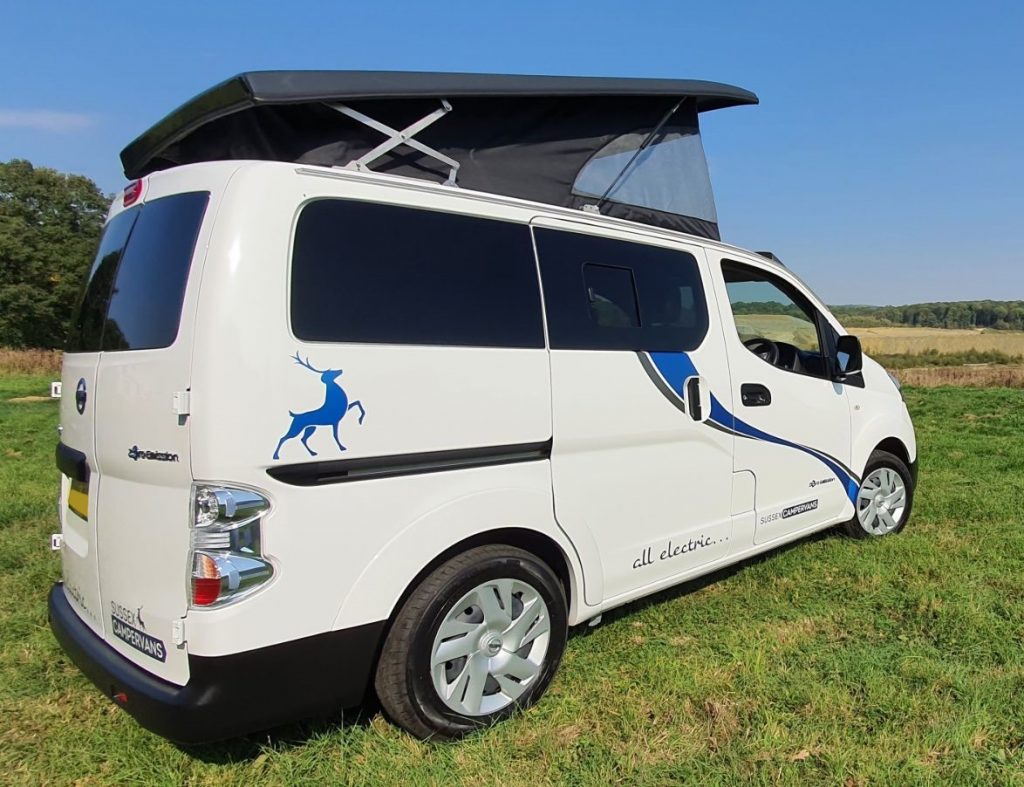
The e-NV200 has been around for a while now. At first it had a 24kWh battery and a range of less than 60 miles. It’s now upgraded to 40kWh, giving a realistic range of around 100 miles. You can actually buy an all-electric e-NV200 campervan today from Sussex Campervans, albeit they haven’t been able to tap into the energy of the traction battery.
Both of these vans, as with all those currently available, are designed for “last mile” deliveries. According to the VW website the 82 mile range of the e-Transporter is “perfectly suited to many different business types”. That is true, but realistically, while these vans would work for relaxed touring and sightseeing, they’re still not really practicable for getting to your holiday location in the first place.
But the I.D. Buzz???? That could do it! With manufacturer cooperation and innovative thinking we could have an exciting and comfortable all-electric van-life experience, and won’t have to be tied to a charging point every night. I’d want one.